






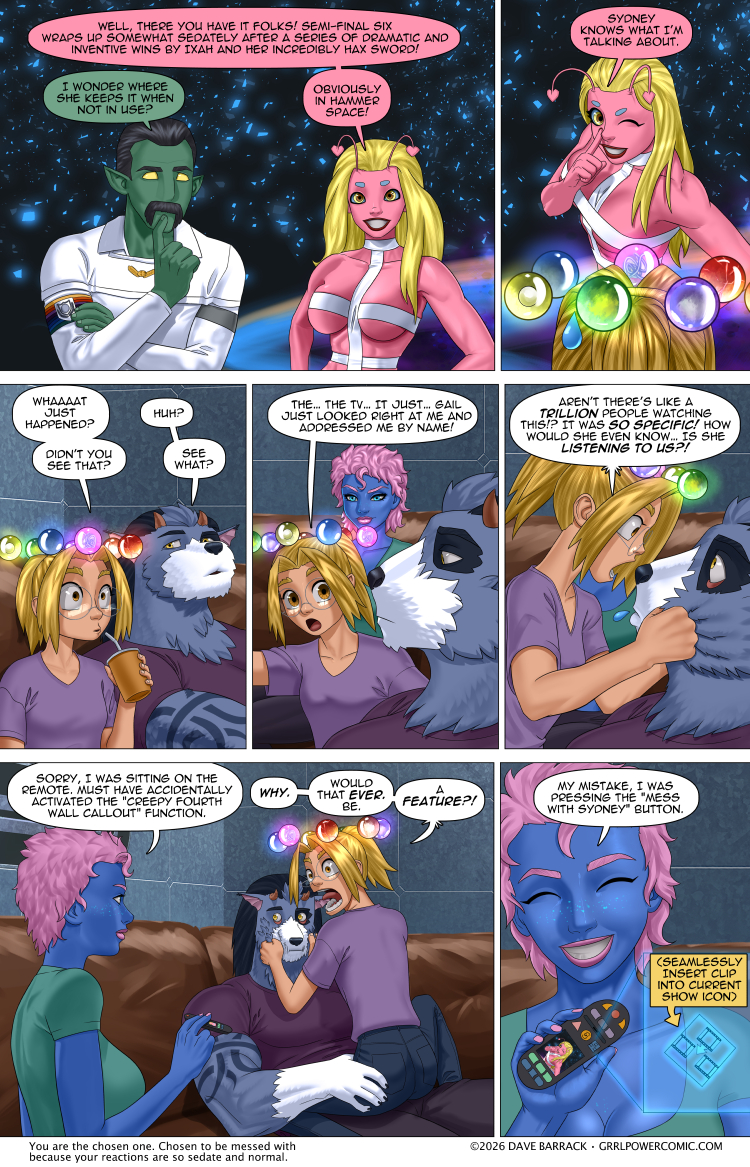
Grrl Power #1489 – Target audience
Ahhhh! Done with the fight scenes for a few pages at least, and back to the characters being goobers. The meat and potatoes of this comic. Feels good. Also not having to draw a bunch of speed lines feels good too. I mean, obviously I have some huge speed line templates that I cut and paste, because there’s usually no point to doing a unique radial burst for each panel, but still. There’s more to good speedlining that just laying lines over or under some action, as I’m realizing, but hey, that’s the job. Still, I wouldn’t say no to 3 or 4 Japanese interns who put in 16 hour days doing mind-numbing background work. Man if I could get that for a single page… well, that page would probably just be an establishing shot of a massive city, because that shit is tedious. That or a lot of rubble.
There was some debate on the previous page about whether Max qualifies as a “Mary Sue,” which in its current common usage, is a term I generally don’t like. Because the original Mary Sue was specifically a female character who is great at everything, but most importantly, also an author self-insert. Unfortunately, the current common usage seems to have become “any competent female character.” Without the author self-insert part, it almost always feels like the person complaining about a female character being good at stuff is really zeroing in on the female part of the equation, and that becomes extremely evident when you ask them, “Is Batman a Mary-Sue?” Because Batman is a billionaire playboy who is better at literally every single physical activity than Olympic equivalents, is also the world’s greatest detective, can outfight like 20 ninjas at a time (dudes who have spent their entire lives training only to be deadly fighters and don’t waste any time on that detective stuff or solving riddles) has all the gadgets, up to and including his own fighter jet armed with a variety of missiles, which is probably illegal for a private citizen in a much bigger way than vigilante justicing some thugs in an alley, has his own space station with orbital strike capabilities, which, again, probably illegal in a way that the entire U.N. might care about, etc, etc. The Mary Sue-accusers usually say, “No, because Batman loses fights all the time.” Right, he loses fights, (usually so he can get thrown in a deathtrap only to quickly escape) but never the war. If a female billionaire playgirl gadgeteer, etc got her back fucking broken rather famously, then recovered and was basically completely fine afterward and proceeded to beat up Bane, I feel like they would get “Mary Sue” lobbed at them. What about James Bond? What about Iron Man? Riddick? John Wick? Mary Sue or just the main character of a franchise who necessarily has to win in the end so the franchise can continue?
But here’s a serious question. If Maxima is a Mary Sue (the non-author insert kind, obviously) because she’s powerful and wins fights… is Saitama? (From One Punch Man if you didn’t know his name.) Saitama is probably exempt because his strength and battle record are almost entirely played for laughs. Also he’s male. I guess the real question is if Maxima was Maximus, would anyone even think of accusing him of being a non-author-insert Mary Sue? Cause I’ve never seen anyone accuse Batman of being a Mary Sue out of the blue, it only ever happens when someone asks the guy who’s accused a female character of being one if Batman is also one, and accuser guy suddenly feels defensive about getting called out for being sexist.
If you think seeing Maxima win a bunch of high-level fights with relative ease is a little boring, that’s fine. That’s a totally valid criticism – even taking into account that she entered specifically because she analyzed previous tournaments and was fairly certain she could probably win with relative ease. That’s still a valid criticism, because it’s on me to relay an entertaining version of those events.
 Oh, look who it is in the vote incentive. And a not-quite-yet-but-it’s-coming NSFW version over at Patreon.
Vote incentive and Patreon updated with some shading. Not finished yet, but progress.
I think she would get in trouble for doing this. She’d mess up the… floor of the waterfall? Is that what it’s called? The receiving pool? No, probably not that. Anyway, she’d churn things up and cause a ton of weird erosion.
Since you might be wondering, Niagara Falls is about 165 feet high, so Babezilla obviously doesn’t have to be full sized. I’d say she’s about 175-180 feet tall here?
Double res version will be posted over at Patreon. Feel free to contribute as much as you like.











Mary Sue classification (or not) really needs to consider the genre. Ultimately, the criticism isn’t of the character, it’s of the way the character fits with the rest of the story and what constraints their portrayal imposes on it. Maxima isn’t a Mary Sue, no matter how powerful she is, because this is first-and-foremost Sydney’s story. If the focal point of the comic was “Maxima: Unbeatable Tournament Fighter”, then it might be more relevant. But Maxima being more powerful than everyone else is a key component of her relationship with Sydney, and exploring/challenging that aspect of her character in a fun mini-arc is good writing, not bad. This is also why most action movie characters don’t really count, even if they’re more than powerful enough – their power enables the story rather than constraining it. Similarly, Saitama’s story isn’t about “is Saitama strong enough”, it’s about the humor and drama you can find when you take that question entirely off the table.
The reason Rey comes off as a Mary Sue to so many people is that the movies (at least the first two, I personally argue that this is a problem that was fixed in the third) present “is Rey capable enough” as a core question of the plot, but the way the scenes with her are actually written don’t portray that as a real question. Captain Marvel (to grab another hot-button) is approaching Saitama levels of power, but also (in my opinion) avoids the Mary Sue classification because the story is never asking the question “is she strong enough”, it’s asking “of course she’s strong enough, but can she get her head on straight enough to actually use that strength and figure out the right way to point it”.
To pull from anime, Ichigo from Bleach was enough of a Mary Sue that it eventually killed my ability to enjoy that series. One obligatory loss at the start of a plot arc, then a training montage where it’s discovered that he’s yet another type of prodigy or chosen one, then some minor character fights interspersed with Ichigo curb-stomping some mooks, then a climactic fight that he wins with a mid-battle powerup that appears the moment he’s about to be actually challenged. I started skipping over his fights and focusing on the side characters long before I stopped watching entirely. The problem, as always, was that the story was asking “is Ichigo strong enough”, but the structure was telling us that wasn’t even a question.
Similarly, I find Batman more fun to read in an ensemble cast than in a Batman-focused book. Normal human enemies can’t challenge him and normal human allies can’t stand beside him. But making him the “normal” human on the Justice League (trying to handle threats that can casually slap Superman) works for me in a way his solo stories rarely do (there are always exceptions, but that character has had more misses than hits for me).
Flagging criticism of poorly written female characters as sexist is a shiny new toy that megacorporate marketing departments are having a lot of fun playing with. But we don’t need to do their work for them. Ultimately, the believability and enjoyability of a story are intensely subjective judgements. I’m much more concerned about corporations that have merged with half the planet trying to claim that not liking their latest slop is a moral failing of the audience rather than a quality failing of the product. And people using a term that got assigned to a common character writing failure mode doesn’t particularly distract me from that.
Actually, a Mary Sue is never the Main Character: that’s the whole point, a MS is not even a secondary character, they are someone who shows up out of no where, with barely any introduction and is able to solve everything and is accepted (and beloved) by everyone (including the villain)
It’s also not about “are they strong enough” because it’s not even always about physical strength
And you actually described why Batsie is a Marty Stu: he is a ‘base’ hyu-mon, but is able to stand shoulder-to-shoulder with the likes of Soupcan and Wonder Woman against foes such as Darkseid… and is usually the one who comes up with the solution (or is the catalyst for it)
Going back to the original “A Treckie’s Tale”, Mary Sue is actually the main character of that story. Praised by James Kirk because she “is not that kind of girl”, praised by Spock for her flawless logic, and so on.
Yes, “A Treckie’s Tale” is the parody of a parody. but it hit on the head and the name of its protagonist stuck. (And the date of Mary Sue’s death is still a holiday on the Enterprise, spent lamenting the loss.)
I think the idolatry is an important element of whether a character is a Mary Sue. Someone who is supremely powerful, but still has ordinary interactions with other characters can be the star of a story that’s ABOUT those interpersonal struggles that everybody on Earth faces. If you flipped that coin: your new OC walks onto the set, fails at nearly every task set before them, but the cast still falls in love with them, that’s the same kind of bad writing. Sailor Moon is the most powerful character ever written, but despite holding the power to create and destroy multiverses with a wave of her hand, she’s still a PERSON with issues and hangups and homework.
I want to second this. Mary Sues are bad because they distort the story around them, making them the central character regardless of any other considerations. This storyline puts her front-and-center sure, but this is the exception, not the rule.
Maxima fighting things and winning in 2 pages per enemy is easily the most interesting thing that’s happened in the last 300 pages. It’s maybe the only time in this entire comic that a fight has felt well-paced. I just wish it quit cutting back to these idiots on the couch reacting to everything like fourth-string Dragon Ball Z characters. The commentators and Maxima’s thoughts should be good enough on their own to break up the action.
I think another thing to remember about Mary Sue is that the term originated from Fan Fiction. I.E. it is a character inserted into another universe that then twists everything to be about them rather than the original characters.
Now the term has obviously evolved to be inclusive of more than just fan fiction, but characters that would be Mary Sues if transplanted into another work are not necessarily Mary Sues in their own works.
Batman is an interesting example. I have heard him referred a lot as a Mary Sue type character, but usually only when talking in a crossover sense. In his own universe he is mostly fine much of the time(depending on writer). However, once he starts teaming up with Super Man or the likes and he gets played as being able to go toe to toe in straight physical brawl not only does that tend to really push the suspension of disbelief, but it also effectively requires the other hero’s universe to ‘bend’ to accommodate Batman, at which point bad enough writing can definitely push that to Mary Sue territory. Batman The Brave and the Bold is a fun one; the Music Meister episode has a fun song that kind of tongue in cheek makes fun of Batman being ‘too good’, with Aquman and Green Arrow singing “Other Heroes often ask why is he always the top cat”. However this brings up another thing that the Mary Sue definition isn’t really designed to encompass. Comedy series. Being absurd is a fairly typical Comedy technique and so overpowered comedy characters will often have Mary Sue like traits; however if the work isn’t taking itself seriously it is really tough for the character to be a true Mary Sue. Because if everything is absurd then it is less Mary Sue twisting the universe to fit them, and more that they just happen to fit the universe.
Wow… 3 pages of comments? And only ~90% are about who or what is or isn’t a “Mary Sue”.
And no, IMHO, Max absolutely is not a Mary Sue. The original Mary Sue character had nothing whatsoever to do with super power or strength. Exactly the opposite, in fact. She was created as a parody to satirize the large number of woman-written Star Trek fan-fic stories with the obvious idealized self-insert female character. She was always an unreal combination of beautiful, intelligent, charismatic, wise, courageous, and lucky. Never super strong usually not with any powers (although some were human “hybrids” with abilities). Typically the youngest ever female [character’s rank] in Star Fleet, able to solve any problem using her wits, lead crews with ease, everyone loves and adores her, and always with at least one or several handsome/hunky love interest(s) (often Captain Kirk himself). Often dies in a noble sacrifice to save the crew / her love.
Max meets none of those criteria.
I realize the trope has jumped from a specific franchise to the overall scifi/fantasy/superhero genres and the definition has changed with time. Arguably any real meaning for the term is long lost to the point where today it’s a nothing more than a pejorative tossed out by anyone who dislikes a strong female character for any reason. We see that in the comments here.
Again, no, Max is not a “Mary Sue”.
No need to rip Frix’s face off.
Well…Now I know how to make the discussion threads blow up. Just accuse a character of character of being a certain type of trope.
Calling Max a Mary Sue belies a misunderstanding of how the term is used. The problem with a Mary Sue character is that they act outside their own character to solve problems and overcome difficulties. Rey is a Mary Sue because she was able to duel Kylo Ren to a standstill without having any lightsaber training. She was able to move a huge pile of rocks without knowing how to lift one before.
A Mary Sue breaks the established rules of the story’s setting. Max does not. She is literally an example of how broken supers are in this setting, which is one of the points that keeps coming up in the story.
That is also my understanding of the term. The Mary Sue has whatever ability is needed to fix things, yet without an in-story logical basis for her to have obtained said ability. And most of the time, will do it better than those who have trained for years in said ability.
Everything seems to come easy for them, and they just “happen” to be able to do whatever was needed at the time, as if they had been doing it their whole life.
On the other hand, Maxima has an established history, from her gaining her powers, to her spending time in the army using and honing said powers, so that she is now the most powerful super known to man (so far). So of course, if she has studied past Ultimate Combat videos, she has a good idea of how to proceed. (Indeed, she probably would not have done so, had she determined that she was not quite up to the required power level, after watching said videos…)
Definitely not a Mary Sue. A very powerful super, yes. But not a Mary Sue.
Really thought this was a *fourth-wall-breaking alien* moment.
Instead, it was an alien breaking the fourth wall moment.
you joke, but 10 years from now, this is how product placement in media will be done